From planning actions to interpreting the contract to building this website, it’s the committees of our USA colleagues that keep things moving forward! Learn more about what they do and how you can join below.
Stewards Council
Chief Steward: Camille Godbout-Chouinard
The Stewards Council consists of the district stewards, Chief Steward, and is often attended by our MTA Representative, the USA President or Vice President, and other members of the Executive Board as needed. The Council meets monthly to discuss ongoing issues, coordinate on member outreach, and review sections of the USA contract. Currently, our members are divided into 13 districts, making each District Steward responsible for representing 50-100 members, based on their primary work location. Find out your district and steward here!
A district steward is the first line of defense for union members and serves as their direct connection to the union. Stewards enforce the contract, support members in the workplace, and represent them during Loudermill hearings. The steward is the face of the union for their district with the important role of being directly in touch with members to support and empower them in their workplaces. A contract is only as strong as it can be enforced – otherwise it’s just a packet of paper. As members and stewards identify and address contract violations, we can hold the University accountable and maintain our rights as employees. The Stewards Council also allows us to be a bottom-up union that engages its members to inform our union’s mission and priorities.
HOW TO JOIN: Typically stewards are elected every two years. These elections happen on even election years, opposite from the board elections. When there are vacancies outside of the election cycle, stewards can be appointed by majority vote of the seated board. Members who are interested in becoming a steward should reach out to our chief steward, plan to attend a monthly meeting to get a sense of what we talk about and expectations, and should review the MTA Stewards Handbook (PDF Link) for more info.
TIME COMMITMENT:
| Required hybrid monthly Stewards Council meeting (currently held on the last Monday of the month, 12-2pm) | 2 hours/month |
Member outreach and communications such as:
| 1-3 hours/month |
| Occasional representation for members, as needed | 0-2 hours/month |
| Total | 3-7 hours/month |
Organizing Committee
Co-chairs: Ian Sedelow, Adam Feldman, Camille Godbout-Chouinard
The Organizing Committee (formerly known as the Contract Action Team or CAT) is a group of volunteers who organize events to support the bargaining team during contract negotiations and to defend the contract when it’s under threat. These actions can include:
- Rallies
- Informational pickets
- Marches
- Other public demonstrations
Organizing Committee responds to challenges from management, the state government, or even the federal government that may affect union members or the contract.
HOW TO JOIN: This is an open committee that does not require appointment. Reach out to any of the co-chairs to learn more and receive the Zoom link.
TIME COMMITMENT: The committee meets every other Friday from 12-1 pm on Zoom.
Communications Committee
Coordinator: Deborah Place
The Communications Committee is a group of rank-and-file volunteers facilitated by the elected coordinator who work together to keep you and your coworkers informed and engaged with the union through emails, newsletters, social media, the website, and more!
If you have writing, editing, social media, graphic design, video creation and editing, or website management experience, there is a place for you on the committee. We currently have the following subgroups: Emails & Newsletters, Social Media, and Website.
HOW TO JOIN: If you’re interested in joining the committee, please reach out to Deborah Place. Membership requires appointment by the Executive Board.
TIME COMMITMENT: The committee meets biweekly on Wednesdays from 12-1pm over Zoom, and work asynchronously in between meetings. The time commitment varies depending on the project and time of year.
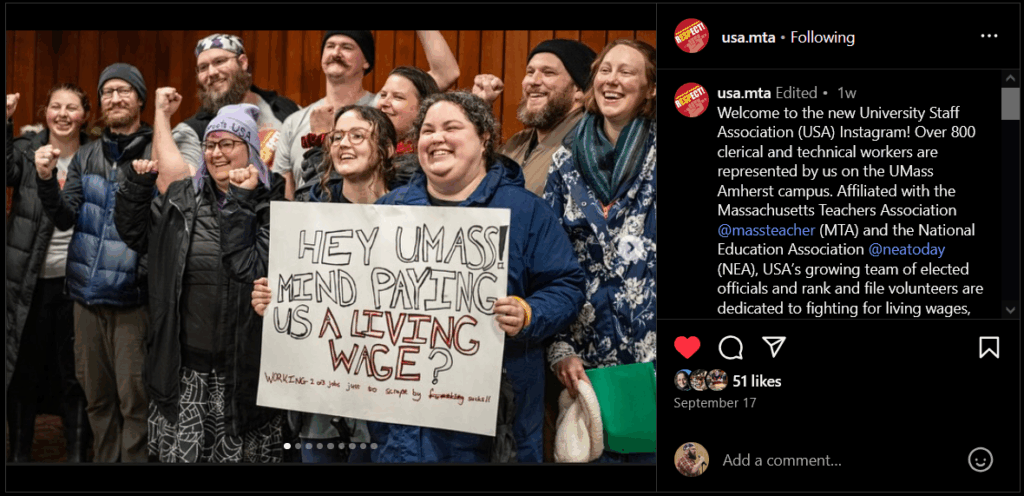
The Communications Committee wants to meet members where they’re at so we recently made an Instagram! Follow us @usa.mta
Health and Safety Committee
Coordinator: Casey Krone
The Health & Safety Committee is a group of rank-and-file volunteers facilitated by the elected coordinator who work together to discuss and address health & safety related issues our members experience in the workplace. From mold, pests, and temperature issues to accessibility to snow and ice removal, the Health & Safety committee advocates for a safe working environment on campus!
HOW TO JOIN: If you’re interested in joining the committee, please email Casey Krone.
TIME COMMITMENT: The committee meets on the second Wednesday of each month from 12-1pm over Zoom and work asynchronously in-between meetings. The time commitment varies, but mostly involves attending committee meetings and occasionally other projects as determined by the committee.
Classification Committee
The Classification Committee is made up of volunteers committed to guiding our peers through the reclassification appeal process. We help with the filing of the initial appeal form, answer any questions about the process and what to expect, and serve as a union representative during the initial desk audit & any follow-up meetings. The reclassification process is a way to get a position upgraded to a higher pay grade if certain criteria within the role are met.
We invite any and all USA members to join the Classification Committee. No special skills are needed, just a desire to help your fellow members, with compassion and patience, through what can feel like a stressful process. It would be an added bonus if you have gone through a reclassification appeal yourself, but certainly not necessary. You will learn the process by shadowing a current member through a meeting with the appellant & in a desk audit before repping independently.
HOW TO JOIN: If you’re interested in learning more and/or joining the Classification Committee, please email Alycia Fabry.
This committee is urgently in need of new members.
TIME COMMITMENT: It varies depending on the member you are helping, but it’s usually a max of 3-4 hours spread out through the process, including an individual meeting at the beginning of the process and the desk audit which usually last 1-1.5 hours. We do not have regular meeting times but check in with each other regularly and meet when needed.
Grievance Committee
Grievance Officer: Ian Sedelow
The Grievance Committee is largely responsible for filing grievances, attending grievance hearings, and ensuring that grievance timelines are upheld. While the Grievance Committee is a closed committee that does not take appointments, the Grievance Committee works closely with the Stewards Council to ensure that stewards from the grievant’s district are present at Grievance meetings.
The Grievance Committee is made up of the USA President, USA Vice President, Grievance Officer, Chief Steward, and the MTA field representative.
You can learn more about the grievance process on the Grievances webpage.
Research Committee
The Research Committee is responsible for developing tactics that will aid USA and other UMass unions in bargaining, escalating actions, and beyond. Everything we do depends on solid research, and this committee will work in conjunction with other UMass unions to deliver the data needed to connect the dots.
Relevant skills include spreadsheet mastery, a desire to pour over state law and parse contract language, and a keen eye for detail. But a natural curiosity and willingness to learn is all it takes to join.
HOW TO JOIN: If you’re interested in learning more and/or joining the Research Committee, please email Chris Weeks.
TIME COMMITMENT: This committee is just getting off the ground and will meet as-needed for now. We have a Teams chat and will decide the future of the committee together. Help shape the future of union research!
Negotiations Committee
Note: Officially, as of July 2025, the Negotiations Committee is inactive. The Negotiations Committee expects to resume around the expiration of the current USA contract in 2027. Side-table negotiations and impact bargaining typically require subcommittees comprised of volunteers to negotiate their contents. Under the USA Constitution, these members are appointed by the USA President, and these sessions can be a great way to learn how negotiations work. Keep an eye on your inbox for opportunities to volunteer!
The Negotiations Committee is the elected body of USA members tasked with handling the collective bargaining process between USA and University management. Some of the duties of the Negotiations Committee include:
- Defining the strategy of the bargaining team in contract negotiations
- Developing proposals related to wages, working conditions, and other mandatory and permissive subjects of bargaining
- Coordinating with the Communications Committee, Organizing Committee, Silent Bargaining Representatives (SBRs) and other groups to build support and leverage for established bargaining platforms
The Bargaining Team is a subgroup of the Negotiations Committee charged with directly negotiating with the employer during collective bargaining. Members of the Negotiation Committee are permitted to serve alongside other USA members and allies as Silent Bargaining Representatives (SBRs), who participate in bargaining caucuses and silently represent USA at the bargaining table. They are not observers – they are duly appointed and recognized by the USA Executive Board to be present in negotiations, in accordance with Belmont School Committee v. Belmont Education Association.
Political Action/Social Justice Committee
Coordinator: Tim Pyne
Note: This committee is currently dormant.
Committee description from the USA Constitution: The Committee shall encourage members to exercise their civil and political rights and shall keep them informed of new legislation, administrative and state rule making and policy formation. Finally, the committee shall work to establish effective cooperative relationships among employees and community organizations. The Committee shall also develop and promote activities as appropriate to further the civil and human rights of employees and other members of the University community, address issues relating to classism, promote diversity, and establish effective cooperative relationships among employees and community organizations. The Political Action/Social Justice Coordinator shall chair this committee.
The Political Action/Social Justice Committee shall plan, develop, and promote activities as appropriate to further the civil and human rights of employees and other members of the University community and actively work to promote diversity, while addressing issues relating to classism, racism, and gender equity. It shall have a broad concern for state and national legislation and for the University and state administrative rule making and policy formation affecting the interests of the Union. The committee shall also develop and/or coordinate proposals for the continued education of Union members, including proposals related to the Career Ladder and Workplace Education Programs.
Retired Members Committee
Note: This committee is currently dormant. If you are a retired USA member who is interested in jumpstarting this committee, please reach out to the USA office.
Committee description from the USA Constitution: The Retired Members Committee shall make recommendations regarding the interests of the Union’s retired members and retired bargaining unit employees. The Retired Members Committee and its members may consult with other committees.